ADAS Calibration After Windshield or Bumper Replacement
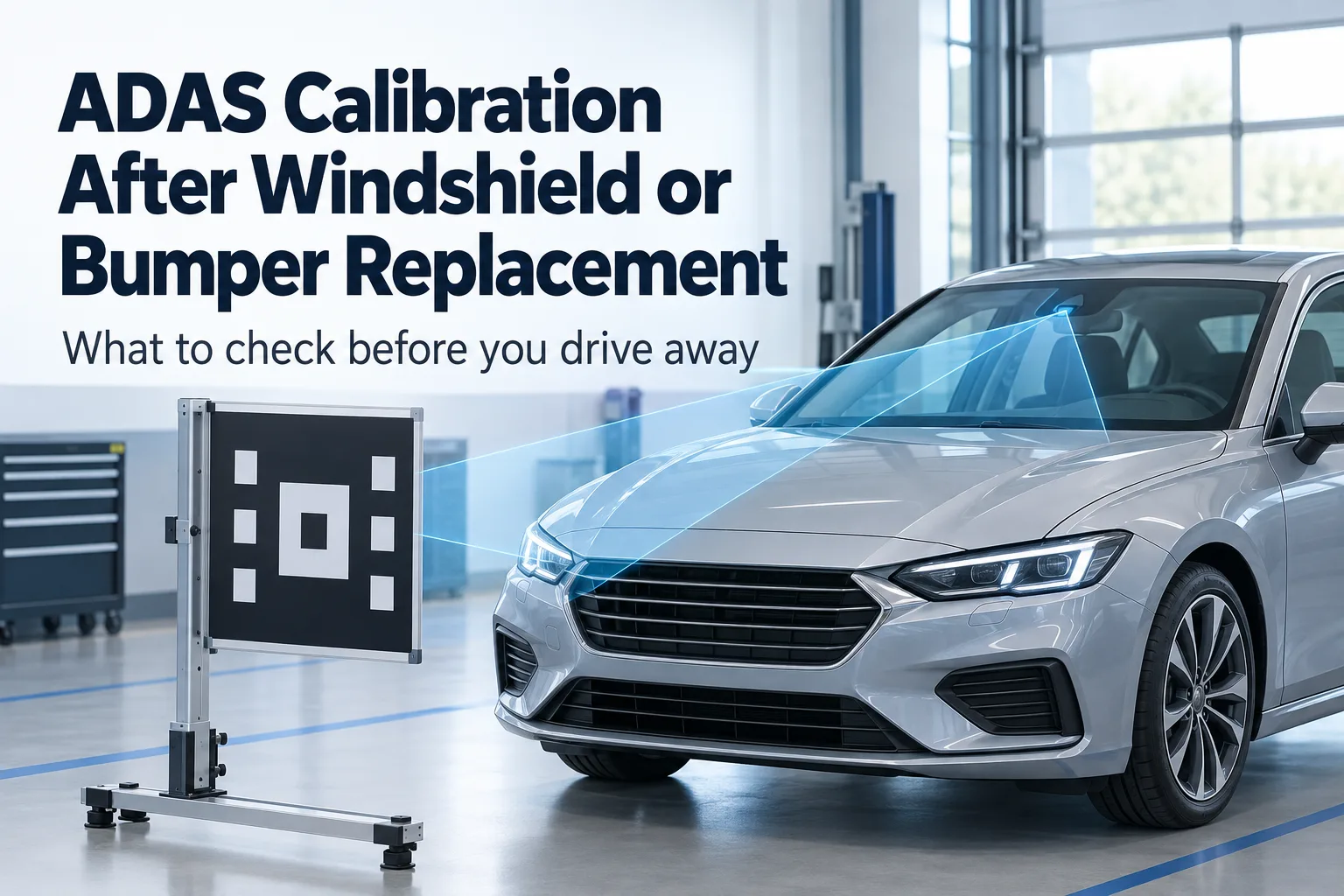
Yes, you usually need ADAS calibration after a windshield or bumper replacement. The forward camera typically sits behind the windshield, and radar and parking sensors sit in or behind the bumper cover. Move the glass or the cover and the sensor's view changes, even by a small amount. Your car's manufacturer sets the procedure for your exact vehicle, and that decides whether it needs calibration and which kind. A clear dashboard doesn't answer the question.
The part that came off tells you which sensors to check
ADAS (advanced driver assistance systems) covers lane-keeping, automatic emergency braking, adaptive cruise, blind spot warning and parking sensors. Each one relies on a sensor aimed at a specific spot. Roughly:
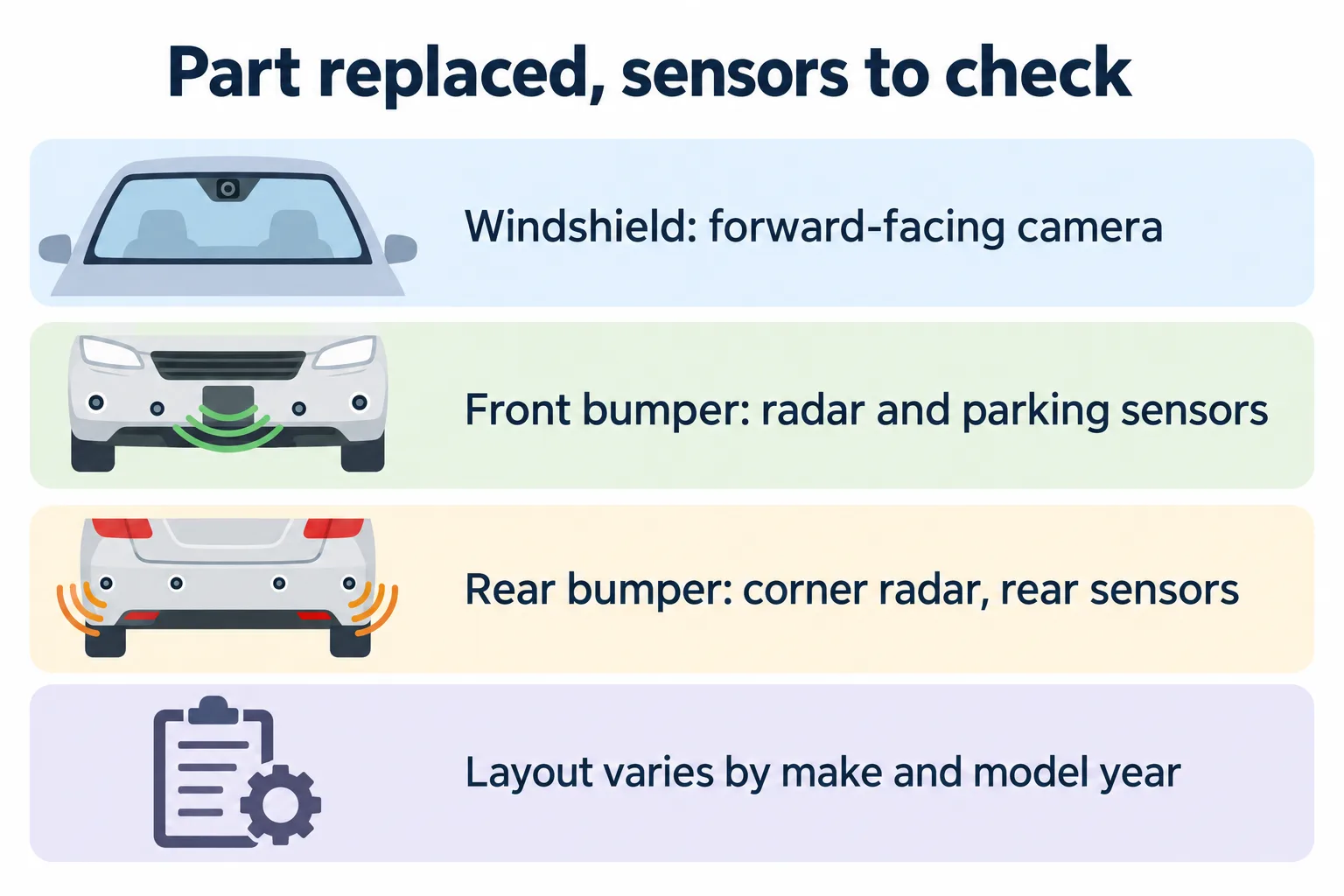
- Windshield replacement: the forward-facing camera mounted at the glass. It reads lane lines, signs and vehicles ahead. A new windshield, or even a re-seated camera bracket, can change its aim.
- Front bumper replacement: radar units behind the cover (often used for adaptive cruise and emergency braking) and ultrasonic parking sensors in the cover itself.
- Rear bumper replacement: corner radar for blind spot and rear cross-traffic alerts, plus rear parking sensors.
Layout varies by make and model year, so treat this list as a starting point. Your vehicle's repair information settles it.
No warning light does not mean the sensors are aimed correctly
This is the most common wrong assumption. A system can pass its self-check, show no fault, and still be looking a degree or two off. A slightly misaimed camera has no idea it's misaimed. It reports lane lines and vehicle positions with full confidence, just in the wrong place.
So a clean dashboard after the repair proves very little. What matters is whether the calibration ran and whether there's a record of it. A post-repair scan and a calibration report are the evidence. A test drive that felt normal is not.
Static or dynamic: the manufacturer decides, not the shop's habit
There are two broad calibration methods:
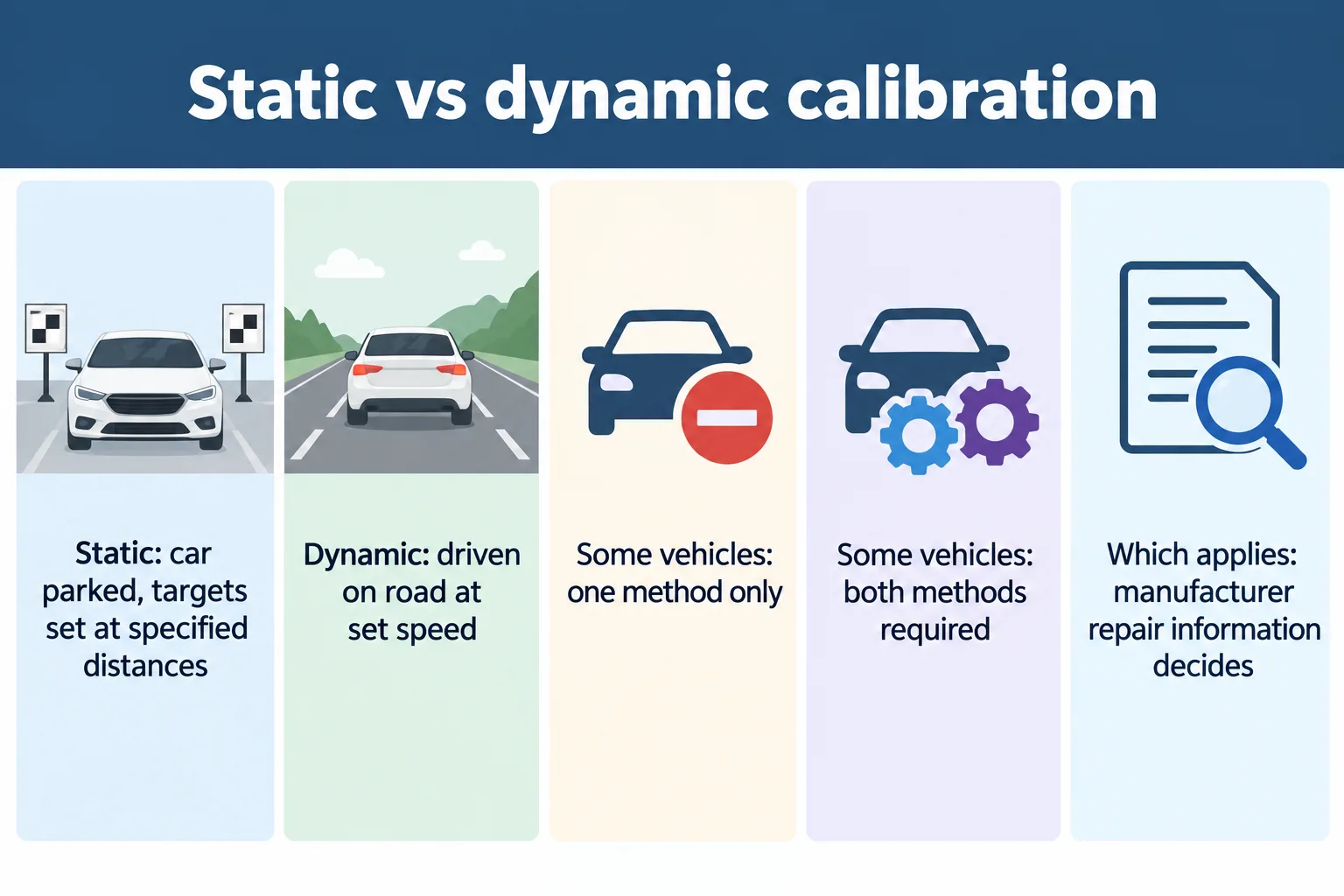
- Static: the car sits in a controlled space while the shop positions targets or reflectors at specified distances and heights, then runs the calibration with a scan tool.
- Dynamic: the car is driven under specified conditions, such as clear lane markings and a set speed, so the system learns its aim on the road.
Some vehicles call for one, some the other, and some for both. Be skeptical of anyone who says every car just needs a drive to self-calibrate, or that every car needs targets. Both answers are shortcuts. Ask which procedure applies to your car and where it comes from. A straight answer points to the manufacturer's repair information for your make and year.
Get alignment settled before calibration, not after
Many calibration procedures assume the wheels and suspension are in specification, because the sensors are aimed relative to the direction the car actually travels. Say a collision bent a control arm or knocked the alignment out. Calibrate the camera first and you lock in the error. Then the alignment gets fixed, and the aim is off again.
In a collision repair, order matters: structure and suspension first, alignment next, then calibration, then a final scan. If your car also drifts on the freeway after the hit, say so. That points to alignment or suspension damage, and it should be dealt with before anything electronic gets aimed.
Ask for calibration on the estimate before the part comes off
Calibration is easy to miss on a first estimate because it isn't visible damage. Before work starts, ask three things:
- Is calibration listed as a line item for the sensors affected by this replacement?
- Will it be done in-house or sent out, and who is responsible if it fails afterward?
- Will I get the pre-repair and post-repair scan results, and the calibration report?
If an insurance claim is paying for it, calibration can surface after teardown, when hidden sensor brackets or damaged mounts show up. That's normal and usually handled as a supplement to the original estimate. Our guide to how insurance claims work after an accident explains how those additions get approved. In California, you choose the repair shop. Your insurer cannot require a particular one. If a shop's estimate skips calibration on a car that clearly has these systems, ask why.
How this works at San Diego Auto Repair & Collision
Our shop is at 3877 42nd St in City Heights, San Diego. Recalibration is part of our collision repair process: we scan the car, repair the body and structure, reassemble, recalibrate systems, then finish with a final inspection and road test. On BMW, Mercedes-Benz, Lexus, Porsche and Audi, we follow manufacturer procedures, including ADAS sensor and camera recalibration. For bumper work, we reinstall parking sensors as part of the repair, and we send photo updates by text while the car is in the shop. You can see the range of work on our services page. Want a second look at an estimate? A free one is available through our contact page or by calling (619) 282-2400.
Questions people ask next
Does a windshield replacement always require ADAS calibration?
Not on every vehicle. But on any car with a forward camera mounted at the windshield, calibration is usually required, or at least has to be checked per the manufacturer. If your car has lane-keeping or automatic emergency braking, assume calibration is part of the job until the repair information says otherwise.
Do I need calibration after a bumper replacement if the sensors weren't damaged?
Often yes. Radar and parking sensors mount to or behind the bumper cover, so a replacement cover, new brackets or a repainted cover can change their position or signal path. The manufacturer's procedure for your model says what's needed. Skipping it because the sensor looks fine is a gamble.
How do I know the calibration was actually done?
Ask for the post-repair scan and the calibration report. A shop that did the work will have them. A clean dashboard and a drive that feels normal prove nothing.
More articles
- Pick a City Heights Auto Body Shop by Its Process, Not Its Address
- Choosing an Auto Body Shop in San Diego: Read the Estimate
- BMW Collision Repair in San Diego: Dealer or Body Shop?
- Bumper Repair in San Diego: Repair or Replace?
- Paintless Dent Repair in San Diego: When It Works
- What to Do After a Car Accident in California